|
How we test
People often ask if
we really can test equipment. The answer is "yes we can!"
Our parent company 'Timestep' were engaged in Satellite Meteorology
and consulted to Inmarsat and BT and have an awful
lot of test equipment. We are able to test to a specific
parameter or advise manufacturers of potential problems. We
can provide pre-review testing before a magazine tests your unit. We can provide expert advice in
customer/manufacturer disputes, or we can just provide
consultancy.
All these
photographs below are of our individual items here in Dartmouth, not library
images! Some people have questioned the age of some
of our test equipment. And this is interesting! Some of it is
brand new as you can see, and some older. To be honest we prefer
equipment that is analogue in feel, some of the new digital test
equipment is Windows CE derived and it isn't appropriate to what
we actually do. We aren't the only ones as HP/Agilent are
desperately trying to get all owners of the HP8903B Audio
Analyser to upgrade by offering huge part exchange values, they
will then probably crush them to keep them off the market. Why ?
well they work so well and once you have one, or three in our
case, you simply don't want to upgrade, and the majority of
users haven't, hence the big incentives. The 8903B Audio
Analysers are so good that there is just one newer model, so we
don't think that one model out is too bad!! If we were to
replace all our test equipment with brand new, including our RF
bench, we would be looking at £1/4 M or more. Most magazines
have far less than we do, and only a very few manufacturers have
any more!
We are working long
term with
Noel Keywood on turntable flutter measurement. This often
forgotten parameter is quite possibly the secret to a good
sounding turntable, and without doubt one of the main reasons
turntables sound different to each other (that and their
suspension). It was us who found Noel's Kenwood FL-180A
and brought it back from the USA by hand.
Recently some have
asked about our owner, so here is a very short biog. Our MD Dave
Cawley served his apprenticeship in the 60's designing magnetic
tape recording heads and is now one of the leading experts on
Weather Satellite technology. He and his company Timestep have
presented several papers to world audiences and did so to
the US Department of Commerce on 11 December 2008 (paper 5.3
click here to see it). In fact Dave
Cawley lectured to the United States Department of Commerce in 2000,
2002, 2004, 2008, 2011 and April 2013. In 2013 Dave was
presented with a Long Service Award by the US Dept. of Commerce. The
audience always includes more than a dozen N.A.S.A. scientists. But what has this do
with Audio? It was once believed that to receive a certain
satellite you had to use a 2.0M dish, very big in fact!, however
Dave worked on a solution using an antenna the size of a
paperback book, to this day no one has achieved anything
similar! The challenge of getting a 5 watt satellite 24,000
miles away to give 60dB signal to noise on a hand sized antenna
is extraordinarily difficult. It is this low noise experience
that rubs off onto audio. In his early days Dave was a senior
electronic design engineer at Philips and remembers it well!
More recently
the AES (Audio Engineering Society) asked Dave to give a
talk at their 2017 Conference in New York click
here to see it and to see how he was introduced click
here. Click
here to
see Dave's AES profile.
Some manufacturers
claim association with a local university to prove the
legitimacy of their work, and why not? However Dave Cawley
is a renowned engineer in his own right who has lectured at both
Universities and to N.A.S.A. scientists, he needs no such
references. These are some of the more notable
achievements taken from a long list:-
In 2008 we advised
two major turntable manufactures on how to use Jelco tonearms
and match them with OEM Shelter cartridges.
in January 2012 a leading turntable manufacturer asked for
help in measuring speed and wow & flutter, we were able
to provide test methods and sources of test equipment for them.
In late January
2012 we looked at a
€26K
turntable from Germany with electrical noise problems, provided
the cure.
March 2012 we
looked at a £9,500 phonostage, diagnosed a problem and suggested
a solution. The manufacturer had not noticed and has now
incorporated our suggestion into the design.
2016 Worked with
HiFi World on measurement of the new Technics turntable.
2017 A major UK
manufacture asked for advice on test records.
"if it measures
well and sounds good, then it is good" : "if it measures badly
and sounds bad then it is bad" : "if it measures badly and
sounds good, then it could be improved" : "if it measures well
but sounds bad then it is bad" © Dave Cawley
|
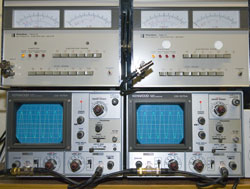
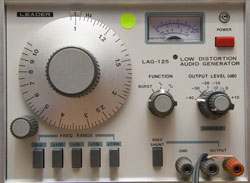
The 'fast
test' area where we use the Leader Low Distortion Audio
Generator to feed the equipment under test. The
results are displayed on two ShibaSoku Automatic
Distortion Analysers and two Kenwood scopes. This
is a very fast and easy first test.
We can
measure gain, level, frequency response and distortion
in a flash! |
 |
 |
|
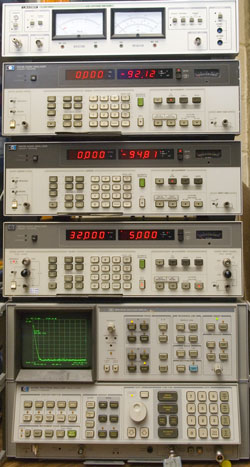
This is the
'main area' a few feet to the right of the 'fast area'.
Starting at the top we have the Leader LJM-1851 CD
Jitter meter, and that is exactly what it measures!
Below are
three HP 8903B Audio Analysers. Why three?
Well, we use the bottom one 'second functioned' to be
just a signal generator, and the top two display level
and distortion on each channel simultaneously.
They will allow measurement of delta functions so that
frequency response can be measured easily. For
phono stages we use a precision 'inverse RIAA' box that
also has an optional Neumann 3.18uS curve added. This way
we routinely measure phono stages up to 32Khz.
|
We have
precision 8, 4 and 2 ohm loads, using the HP 8903B
special functions, they will read power and distortion
directly. |
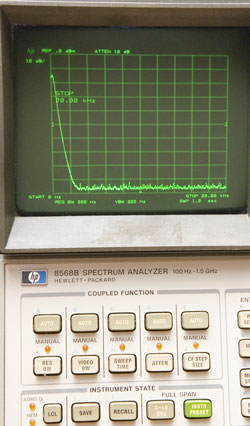
At the
bottom is the HP8568B RF spectrum analyser. With
this we can easily see amplifier instability that often
occurs well outside of the audio spectrum. Also it
has over 30dB more dynamic range than the lower cost
audio analysers, it's a thing of pure joy! |
Here we
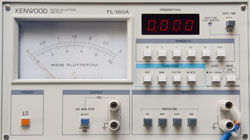
have the Kenwood FL-180A Wow and Flutter meter.
Like
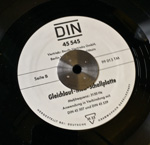
HiFi World we multiple copies of "DIN 45 545", "Denon –
XG-7004" and "JVC TRS-1007". We
have three of "DIN 45 545" including the rare metal centre one
shown here.
We can
also measure speed, the test record is cut at 3.1500Khz
and the built in frequency counter should reflect that.
However, if the turntable is using an AC synchronous
motor running straight of the mains power, we are left
with the unstable 50/60hz, but the FL-180A can be
switched to synchronise from the same 50/60Hz mains,
giving a true 'geared' speed value.
Crystal
controlled direct drive PLL turntables rarely have any
speed error.
We can
get a numeric value for wow and flutter and assess the
demodulated spectrum using the HP 3561A below.
|
 |
|
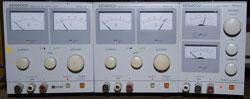
A trio of Kenwood power supplies. Here used to check the
legendary Technics SP-10 turntable in 'safe mode'.
We actually have seven of these lovely units, used from
esoteric phono stages to charging motorcycle batteries! |
 |
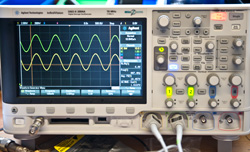
Bought new
in 2012 this Agilent DSO-X 2004 real time 4 channel
oscilloscope with built in function generator and DVM
has revolutionised the way we work.
We can store settings and front panel set ups and even
give them names by plugging in a USB keyboard.
The really cool thing is the real time four channel
display, with each channel colour coded. The lets us
look at all three phases of a direct drive turntable and
the PLL error signal all at the same time. Brilliant!
|
 |
|
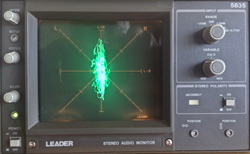
Leader 5835
Stereo Audio Vector Scope. This remarkable
instrument uses a 6" CRT and gives immediate
visualisation of the stereo width, balance, phase and
more. It is especially useful for looking at mono
signals and shows clearly the effect of properly
configured mono switches and mono cartridges. Yes
you can use a PC, but this has zero latency and just
gets on with the job.
What is
interesting is looking at the Beatles LP "With the
Beatles" where the stereo version shows the poor stereo
and the mono version how it should be done. We are
looking forward to evaluating the new Beatles mono vinyl
taken directly from the master tapes later in 2014.
We expect to use the Miyajima-lab Zero African Blackwood
mono cartridge for our tests. |
 |
|
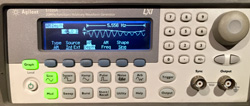
The 2013 Agilent
33220A (option 001) Function / Arbitrary Waveform Generator, allows us to 'pulse' power
amplifiers to get their maximum dynamic RMS power. But
more importantly to simulate waveforms for the Technics
SP-10 development. |
 |
|
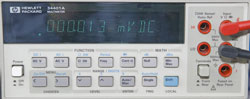
For really
accurate voltage measurement we use the HP 34401A, a
really cool DVM don't you think? 6 1/2 digit
accuracy says it all. Legendary
accuracy and not made in China! |
 |
|
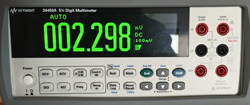
Bought new
in 2016 the Keysight 34450A isn't as accurate as the HP
34401A but has huge digits you can see out of the corner
of your eye. |
 |
|
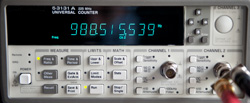
Bought new
in 2012. Agilent 5131A frequency
counter with oven oscillator option 001.
Remarkably this is used to check the speed of
turntables. Over the top ? Yes ! but why not
? |
 |
|
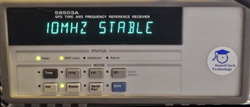
The HP
58503B GPS (option 001)
locked frequency standard is more accurate than a
Rubidium standard and is rated as a "secondary
standard" just one below the world's very best.
This is the genuine HP version not the "clone" re-boxed
Chinese one ! The unit
has a HP 10811D oven oscillator locked to the GPS satellites.
Total lock in stable format can take over 4 hours and
then 0.000001ppm.
That's five noughts one !
|
 |
|
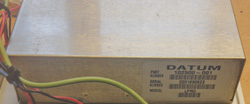
This is one
of our Rubidium atomic frequency standards. This
is a secondary frequency standard that only takes about
half an hour to warm up anywhere. For a quick
measurement nothing beats it this side of many, many
tens of thousands of pounds. But given time, the
GPS clock above will outperform it. |
 |
|
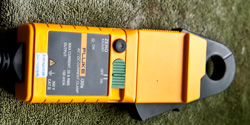
Bought new
in 2011. Fluke i30s high sensitivity, wide bandwidth
current probe. Used to see the actual current draw
of turntable motors, the waveform and stability with the
storage scope above.
There is
another use, and that's to look at the current waveform
of HiFi components and what they kick back into the
mains and hence into everything else. No one has
done this and we can see why............ |
 |
|
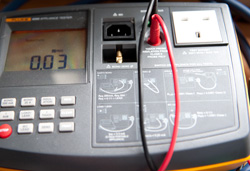
Bought new
in 2012. Fluke 6200 advanced PAT and appliance
tester. Absolutely essential to test electrical
safety. |
 |
|
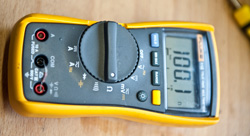
Bought new
in 2011 and 'cos we liked it so much we added a second
one in 2015!. Easy and accurate, that's how you would
describe the Fluke 115 True RMS DVM. It's handy,
always by our side and remarkably accurate. It's
shown here measuring a Vishay 100 ohm MC input loading
resistor. 2015, we liked this so much we bought a
second new one for the other bench !
The HP
34401A above is better, but the Fluke is so simple to
use. |
 |
|
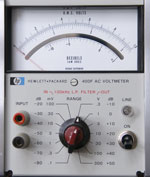
We use this
special 'F' version of the HP 400 voltmeter to
measure power supply noise. The noise floor on the 100uV
range is about 2.5uV, remember that most equipment
rejects power supply noise by about 60dB, so this is a
very small level. But we have plans to go further!
The nature of noise is important, flicker noise is
especially annoying. An average reading meter like
this one, shows you in real time the nature of the
noise. True RMS voltmeters actually suppress
flicker, and do not have the essential 100uV range.
Every power supply made by us is tested on full load and
no load before despatch. |
 |
|
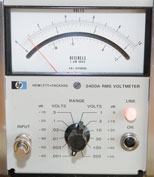
We use
Hewlett Packard 3400A True RMS Meter when specifications
call for RMS measurements. |
 |
|
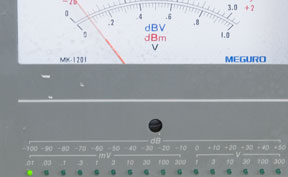
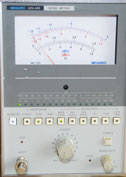
The
Meguro MN-446 Noise Meter is a joy, with its average,
quasi peak and RMS readings it does what no other meter
does. Even in wide band mode as shown its noise
floor is 0.8uV and in weighted less than 0.4UV |
 |
 |
|
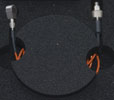
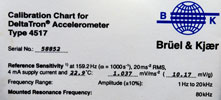
The B&K
4517 accelerometer bought new in July 2009 at the
recommendation of Noel Keywood. |
 |
 |
|
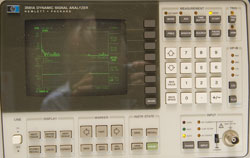
The
infamous HP 3561A FFT Dynamic Signal Analyser, although not
really as 'dynamic' as they could be. This unit
fully meets it's makers specification and is loaded with
options. Using a the accelerometer above we are able to
accurately measure resonance in turntable pick-up arms.
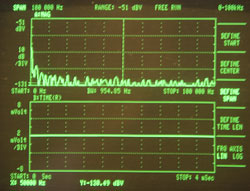
We also use it look at the flutter specrum from the
FL-180A |
Thanks to
Noel Keywood of Hi Fi World for telling us how
to do this. |
 |
|
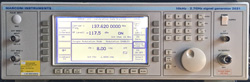
Aeroflex/IFR/Marconi
2031 RF 2.7Ghz signal generator with dual audio signal
generator option, bought new in 1993. We use this
a a reference. |
 |
|
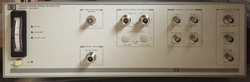
HP 11848A
Phase Noise Interface. This is an on going project
to really test jitter in clock oscillators.
This is a minefield as some replacement clocks are worse
than the original, and some much better. We plan
to use this with custom software and using the National
Instruments GPIB-USB-HS adaptor. |
 |
|
As well as
this pile, we have RF generators, more scopes, AVO's, and
almost another two test benches. Collectors?
us?? |
 |
Membership


Full Member of
AES Audio Engineering Society)
click here
Institutional member of iasa (International Association
of Sound and Audiovisual Archives )
click here
Member of The
City of London Phonograph and Gramophone Society
click here
Institutional
member ARSC (Association for Recorded Sound Collections)
click here
Monday, 22 February 2021 |