|
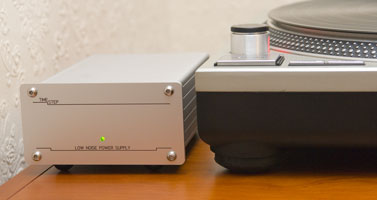
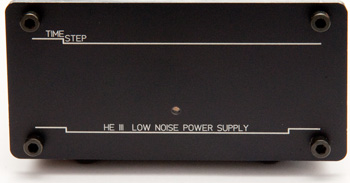
Technics SL-1200 • SL-1210 External Power Supply Unit HE III The SL-1200 has three problems with its power supply and regulator a) the transformer mechanically hums and this is audible through the cartridge, b) the transformer has an electromagnetic field also audible though the cartridge, and c) the existing power supply dips on some motor demands giving variable and poor dynamics to the feedback system.
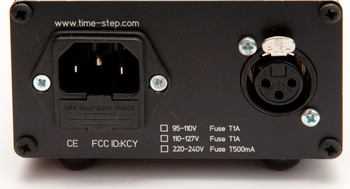
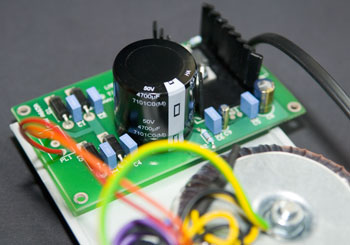
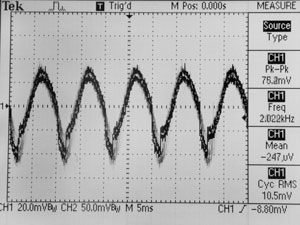
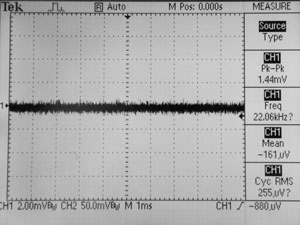
We spent a lot of time on this PSU. It might be tempting just to make a PSU and connect straight into the SL-1200; and some people do just that. However there is more to 'just' adding an external power supply, at least there is if you want to do it properly! We comprehensively analysed the system as a whole, and only then started to design. The internal regulator is way short of gain, so in fact it doesn't really regulate much at all. The motor often demands more current and the existing regulator responds by dropping the voltage. So we completely bypass that regulator, in fact we physically cut it out! Other lower cost power supplies leave in this poor regulator, why you might ask? Let us spell it out, the SL-1200/1210 internal regulator is one big problem, leave it in and simply put on an external power supply; and you only fix half the problem. Cut it out, and use our power supply and everything works properly, look at the scope traces to see. You cannot cut out the regulator with competitors power supplies. Could you sleep at night with a competitors PSU, knowing that it didn't completely solve the problem, and that your deck was suffering from power supply ripple? We didn't think so! A lot of customers have read the above and ask if ours is better than the KAB. Well they are nice guys, but ours is a) a better power supply, and b) ours eliminates the internal regulator ripple. So is it better? yes it is significantly better, so much so that if you have a KAB, you really ought to upgrade, you won't know what you are missing!! The quality of components is critical. We use an expensive x2 overated Nuvotem 'Audio Grade' toroidal transformer and Vishay rectifiers. We now use special order 3 pin high current gold plated Neutrik XLR connectors. We have always used Panasonic FC and HA series low ESR capacitors. We even use 2 ounce double thickness copper on the PCB. And here is the most important, it is all too easily to use a voltage regulator made in China to no particular specification, we use the National Semiconductor LM317HVT low noise regulator, and we use it in low noise mode, not the commonly used application data circuit, there is a big difference!. All units are hand soldered using silver loaded solder. All components are sourced from IS9000 companies. This is not just a power supply, this is a Timestep power supply! To fit it, you simply remove the platter and the plastic plate underneath and solder one wire on, very quick and simple. You only need a screw driver and a soldering iron, nothing more. We supply fully colour illustrated step by step instructions, if you can solder one joint, you can fit this easily yourself. We can do this for you though if you prefer? There is a 1.8M (6 foot) cable that simply plugs into the back of our PSU. The PSU is not switched but goes into standby. 110/120 & 220/240V versions available. 5 year guarantee.
So what does it sound like? In a word breathtaking! The same über firm bass, the usual timing that makes your spine tingle, but with remarkable extra clarity that results from the mechanical and electromagnetic influences being removed. The extra regulation and huge reserves in our PSU remove the occasional wooden or dull sound, giving you relentless dynamics. Someone once asked us about PRAT (pace, rhythm and timing). Yes you get that in shed loads too, but also accuracy, delicacy, and detail (ADD). The future: We have several modifications up our sleeve, they will not all work with other power supplies so buying ours might make even more sense soon! __________________________________________________
Notes from the web, latest one is at the top of this list Note: March 2016: We have lost count of how many 100's we have sold now ! Other manufactures come and go, one required such a difficult installation that a customer completely destroyed their SL-1210 ! We are still the only people who measure PSU's so we "know" how they will perform, no "computer simulations" or "expectation bias" here !
Note: 10 August 2011:
After all this time our SL-1200 PSU is still the best selling! Why?
because we are the only company to work out what the turntable
actually needs and to supply just that. Long pontificating on the
theoretical design of PSU's in general is OK, but at the end of the
day our PSU was designed from scratch to be a SL-1200 PSU, has been
extensively measured, and extensively listened to. There is more to
a PSU than just sticking a LM317 in a box! And now we are seeing
more PSU's with switch mode insides, good grief! Thanks guys for
your support Note: 18 March 2010: Our competitors are claiming all sorts of things, but do they actually measure or simply assume that a computer simulation will work in real life? And do they measure every unit? on the bench using their own (not their mates or where they work) test equipment? You can see part of our test facility by clicking here. Note: 06 October 2009: Power supplies that do not use transformers of any kind are called "Switch Mode Power Supplies" or SMPS for short. They are renown for the plethora of high frequency switching RFI from the huge switching currents and the harmonics produced. Our Regulator does not fall in to the "typical" errors that some designs do. Yes we could quote a meagre 76uV supply line noise, but that would not tell you everything! Note: 15 September 2009: Please note that ours is an audiophile linear PSU with a proper toroidal transformer. A competitor has just released a switch mode power supply ( SMPS ) which will mean even more sales for us! Update: 31 August 2009b (part 2): With a Timestep PSU you only need a screwdriver and a soldering iron, you don't need anything else and you certainly do not need to set it up with a multimeter or anything else. The Timestep power supply comes fully tested, fully set up and completely finished in its own rather nice case. Update: 31 August 2009: It appears our competitors are still clinging on to this, they seem blissfully unaware that the UK mains frequency is 50 Hz and the ripple component is 100Hz, they got confused about the strobe that has a similar but not quite identical frequency. If anything, this reinforces more than ever that you need to come to the experts and they are Timestep! Note: 30 June 2009 (version 4): PSRR has been mentioned by some people, but it is the end result that tells all on our PSU, quite simply we measure noise on a HP400F voltmeter with a noise floor of 2.5uV, remember too that most equipment rejects power supply noise by at least 60dB. Theorising is OK, but measurements tell all! Well we all know about the pitfalls of excessive feedback and a motor control has different requirements to a preamplifier! We are professional designers with a long pedigree. Update: 25 January 2009. Ripple can manifest itself in many ways, especially with a poor regulator and it's often twice mains frequency, just as shown here. The motor simply drags down the original poor regulator, putting a better one in front simply is 'locking the stable door after the horse has bolted' or to be blunt, a complete waste of time! Note: 5 January 2009: Our competitors have made some strange comments, let us clear this up now! The cable we supply is striped and tinned, one end is 2 inches longer and has a solder tag ready fitted so it can only go in one place, therefore polarity reversal is impossible. As we say, we use a National Semiconductor regulator for extreme reliability and over voltage protection. As for the 100Hz, well in the UK the mains frequency is 50Hz and power supply ripple will be (in the UK) 100Hz, exactly as you would expect. In fact on our scope trace we say "under load" and this is the give away!! Two regulators in series, when one and especially the last one in the chain is poor, is simply not a good idea. We are passionate engineers, we measure carefully and freely share our figures and always will! If you want to see our test gear click here. We were in the fortunate position to be second in line, so we were able not to make the mistakes of others, hindsight is truly a wonderful thing! __________________________________________________ 14 March 2016
Sound Hi Fi PO Box 2001 Dartmouth Devon TQ6 9QN Great Britain Telephone 01803 833366 Fax 01803 839498 e-mail sales@SoundHiFi.com |